1943
Prologue
1943 · 2026 · A scroll through the machine age

A Brief History of
Artificial
Intelligence

From a wartime question to a trillion-dollar argument: how a two-month summer project became the loudest story on Earth. Told with real tweets, real panics, real market crashes and one working chatbot from 1966.

Scroll to begin
Chapter 011943 - 1955

Before the machine could think, someone had to ask

It starts with a teenager hiding in a library. Walter Pitts ran away from home at fifteen, taught himself logic from Principia Mathematica, and wrote to Bertrand Russell to point out errors in it. Russell wrote back. In 1943, together with the neurophysiologist Warren McCulloch, Pitts published a paper arguing that neurons were logic gates, and that a network of them could compute anything computable. Nobody built one. It was 1943; there were more urgent machines to build.

Seven years later, Alan Turing, fresh from breaking German ciphers, sat down and wrote the founding document of the whole field. He opened with a question and then immediately refused to answer it, proposing a game instead: if a machine can hold a conversation well enough that you cannot tell it from a person, does the difference matter? He predicted that by the year 2000, machines would fool an average interrogator about 30 percent of the time after five minutes of chat.

He was off by about two decades, and in the wrong direction. Nobody in 1950 guessed the real problem: not whether machines could fool us, but how much we would enjoy being fooled.

I propose to consider the question, "Can machines think?"
Alan Turing, "Computing Machinery and Intelligence", Mind, October 1950
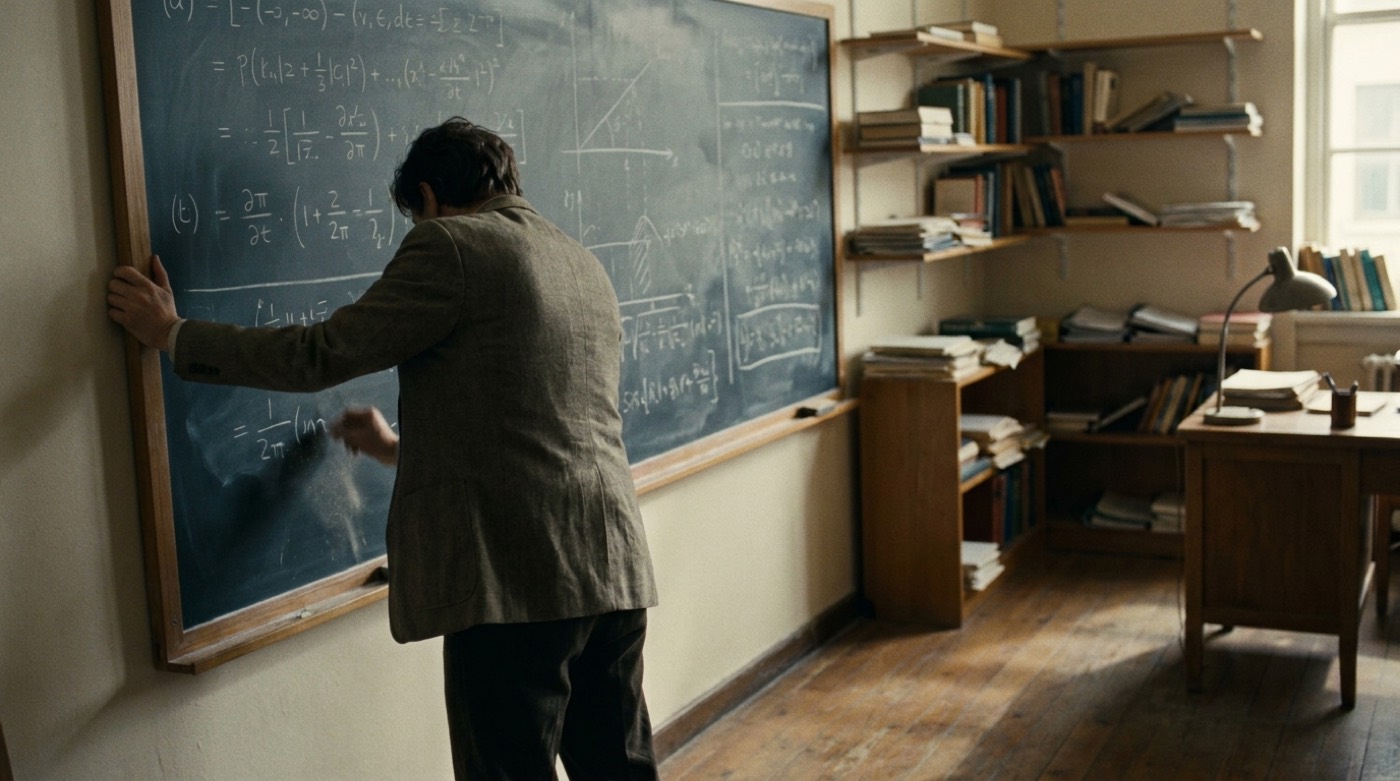
A mathematician at a chalkboard in a dim 1940s office
The question was asked in chalk, answered in siliconfig. 01
Chapter 021956 - 1966

Ten men, two months, and the most optimistic grant proposal ever written

In the summer of 1956, a young mathematician named John McCarthy invited a handful of colleagues to Dartmouth College to solve intelligence. Not to study it. To solve it. The funding proposal remains the most confident document in the history of science: they believed a "significant advance" could be made in machines that use language, form concepts and improve themselves, if a carefully selected group worked on it together for a single summer.

The summer ended. Intelligence remained unsolved. But the workshop named the field ("artificial intelligence", McCarthy's term, chosen partly to avoid sharing credit with cybernetics) and set its emotional thermostat: permanently, gloriously overheated.

The confidence was contagious. In 1958 the US Navy showed reporters the Perceptron, a learning machine by Frank Rosenblatt. The New York Times reported, with a straight face, what you can read in the clipping on the right. In 1965 Herbert Simon declared that machines would be capable of any work a man can do within twenty years. In 1970 Marvin Minsky told Life magazine the general intelligence of an average human was three to eight years away.

Every generation of AI has its "AGI in three years" guy. This field had one before it had a field.

The New York Times · 08/07/1958

NEW NAVY DEVICE LEARNS BY DOING

The Navy revealed the embryo of an electronic computer today that it expects will be able to walk, talk, see, write, reproduce itself and be conscious of its existence.

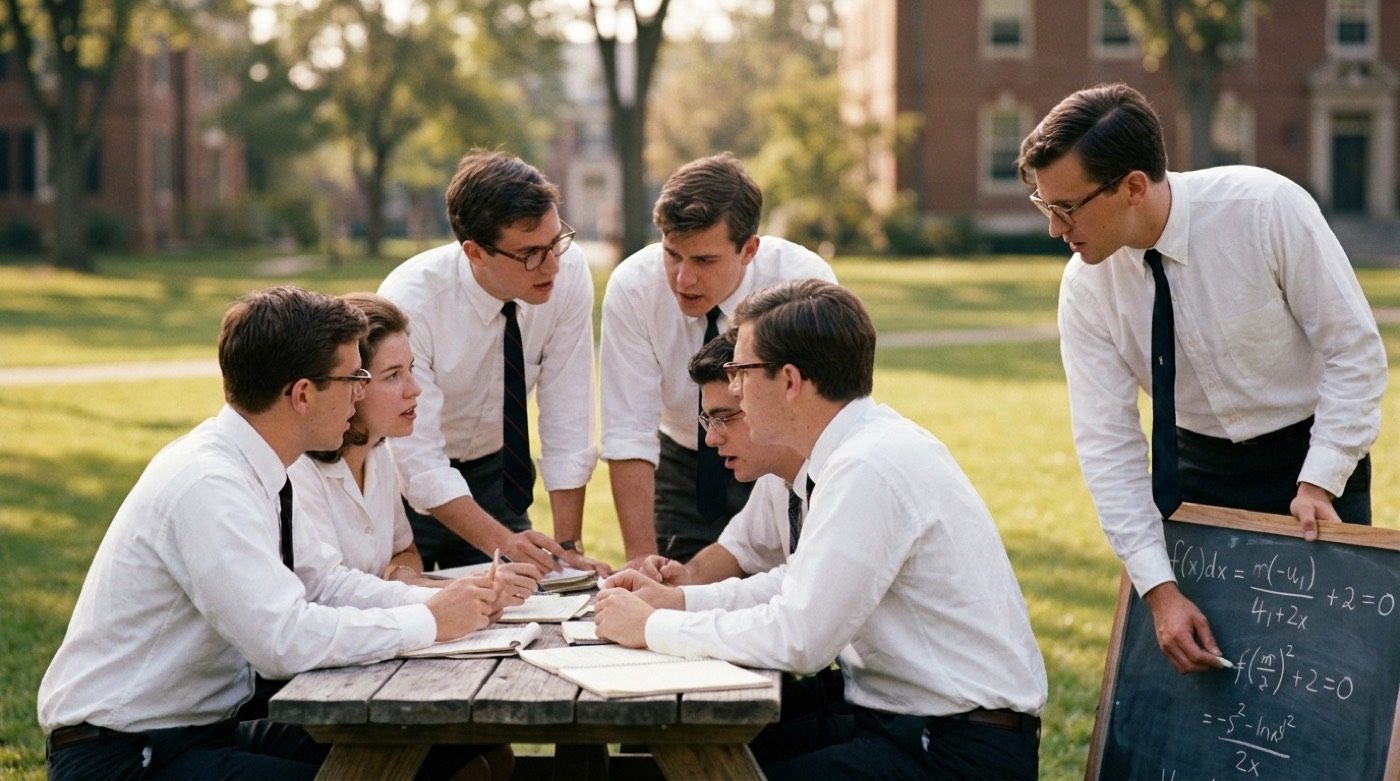
We propose that a 2 month, 10 man study of artificial intelligence be carried out during the summer of 1956 at Dartmouth College.
Dartmouth Summer Research Project proposal, 1955. Budget: $13,500
Scientists around a table on a college lawn, summer 1956
Dartmouth, 1956. The field is born over coffeefig. 02

Then, in 1966, the field produced its first celebrity: a psychotherapist. Joseph Weizenbaum at MIT wrote ELIZA, a 200-line program that parroted your words back as questions. It understood nothing. Weizenbaum knew it understood nothing; he built it to prove how shallow the trick was.

His own secretary, who had watched him build it and knew exactly what it was, sat down at the terminal, exchanged a few messages, and then asked him to leave the room. She wanted privacy. With the program.

Weizenbaum spent the rest of his life warning people about what he had built. Nobody listened. You can talk to his creation below: this terminal runs the real 1966 logic.

ELIZA · MIT · 1966DOCTOR SCRIPT
HOW DO YOU DO. PLEASE TELL ME YOUR PROBLEM.
>

A working reconstruction. 60 years old. Still better at listening than most people.

I had not realized that extremely short exposures to a relatively simple computer program could induce powerful delusional thinking in quite normal people.
Joseph Weizenbaum, on watching people talk to ELIZA
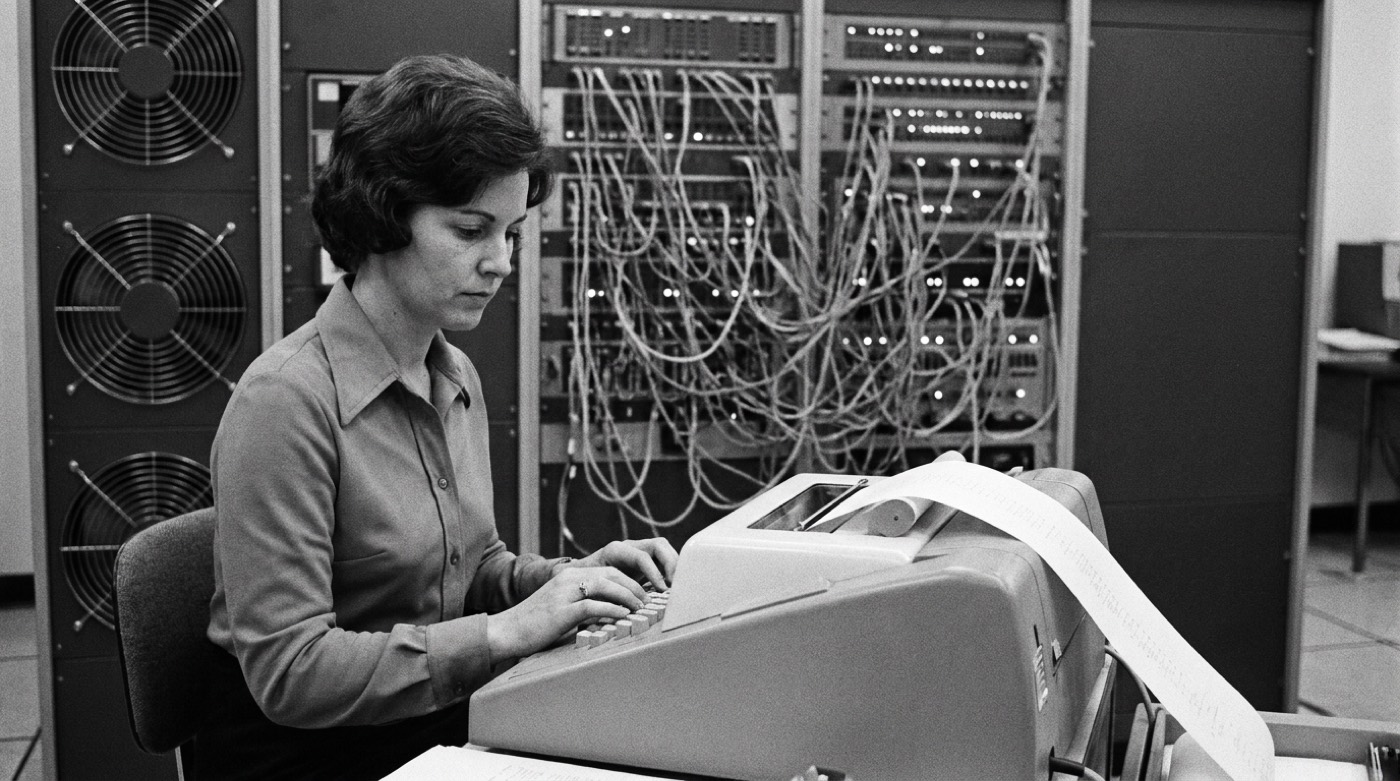
A secretary at a teletype terminal in a 1960s computer lab
1966: the first person ever to prefer talking to the machinefig. 03
Chapter 031967 - 1979

The bill arrives, and the field freezes

The machines of the 1960s could prove small theorems and move blocks around a virtual table. What they could not do was anything anyone would pay for. Machine translation, funded lavishly through the Cold War so computers could read Russian, produced output so bad that a 1966 government report concluded human translators were cheaper, faster and better. The money stopped overnight.

In 1969, Minsky and Papert published a mathematical takedown of the Perceptron, proving a single-layer network could not even learn XOR. The book was correct, narrowly. It was read broadly. Neural network research entered a coma that lasted fifteen years, which is a long time to be right too early, as Rosenblatt did not live to see: he died in a sailing accident in 1971.

Then came the coldest document in AI history. In 1973 the British government asked mathematician James Lighthill to review the field. His report was so devastating that the BBC staged a televised debate where the field's founders defended their life's work against it. They lost the room. Funding collapsed on both sides of the Atlantic. Researchers learned to stop saying "artificial intelligence" on grant applications, a survival trick the field would need again.

In no part of the field have the discoveries made so far produced the major impact that was then promised.
Sir James Lighthill, "Artificial Intelligence: A General Survey", 1973
The first AI winter, 1974-1980. There would be anotherfig. 04 · video
Chapter 041980 - 1993

Expert systems: AI puts on a suit

AI came back in the 1980s wearing a tie. The new idea was the expert system: interview a human expert, write down thousands of IF-THEN rules, sell the result to a corporation. It actually worked, briefly. XCON, which configured computer orders for Digital Equipment Corporation, was saving the company an estimated 40 million dollars a year by 1986. A whole profession appeared overnight, the "knowledge engineer", whose job was extracting rules from grumpy specialists one meeting at a time.

Japan announced the Fifth Generation Computer project and pledged 850 million dollars to leapfrog the West; the US and Britain, terrified, opened their wallets in response. An entire hardware industry sprang up selling machines optimised for Lisp, the language of AI.

By 1987 you could buy a desktop workstation that ran Lisp faster than a Lisp machine, at a tenth of the price. The specialised hardware market evaporated in a single year. Expert systems, meanwhile, turned out to be brilliant right up until reality changed, at which point a human had to rewrite the rules by hand, forever. The second winter arrived on schedule. "AI" became such a poisoned brand that researchers doing AI rebranded it as "machine learning", "informatics", or "pattern recognition", a linguistic witness-protection program that lasted twenty years.

0
saved per year by XCON at DEC
0
Japan's Fifth Generation bet
0
for the Lisp hardware market to die
0
AI winter, 1987-1993
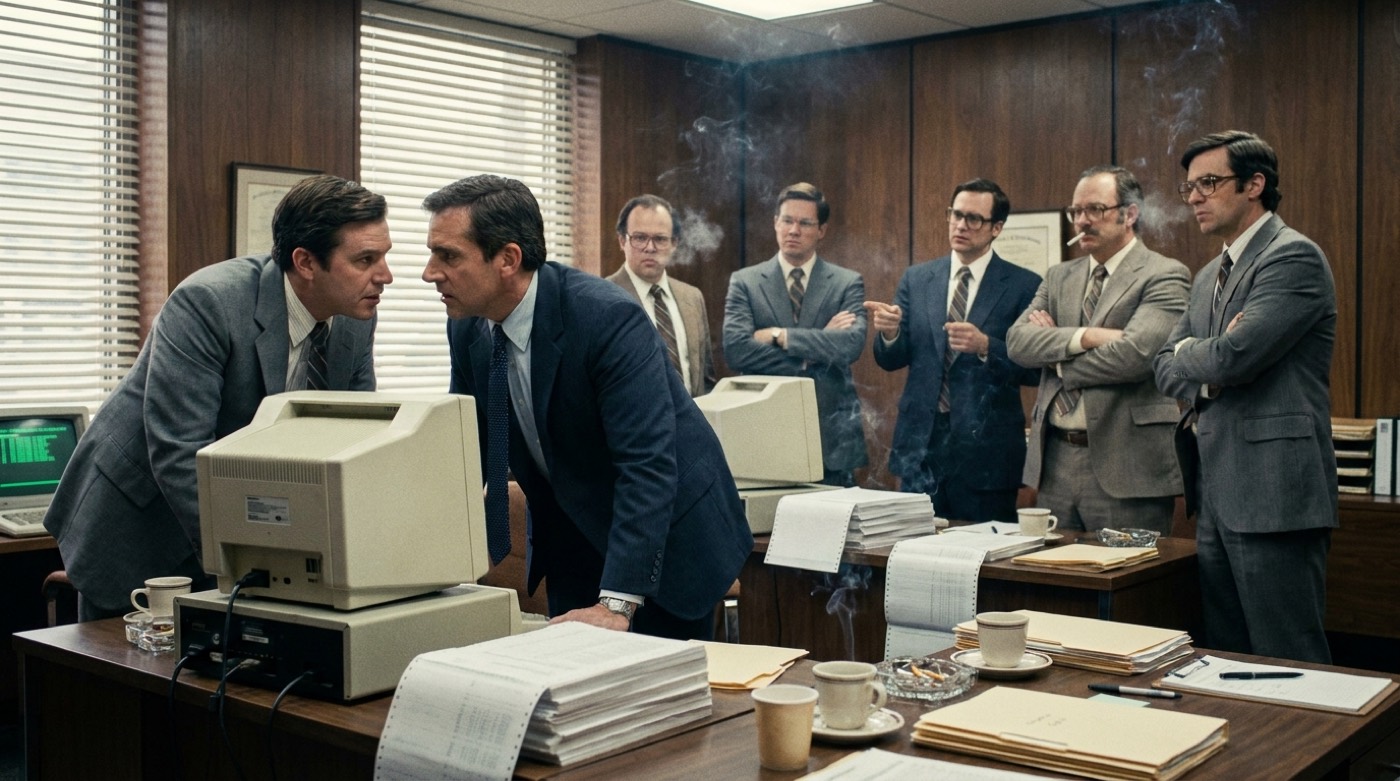
1980s businessmen around green CRT terminals
1985: the future was 10,000 IF statements and a smoking sectionfig. 05
Chapter 051994 - 2011

11 May 1997: the best human loses, and takes it personally

Garry Kasparov was not just the world chess champion; he was arguably the best who had ever lived, and he knew it. In May 1997, in a Manhattan skyscraper, IBM's Deep Blue beat him 3.5 to 2.5. It examined 200 million positions per second and had an entire team of engineers and grandmasters retuning it between games, which Kasparov considered cheating, and IBM considered engineering.

The psychological breaking point had come earlier, in game one. Deep Blue played a strange, pointless-looking 44th move. Kasparov's team stayed up all night trying to understand the deep strategy behind it. There was no deep strategy. Years later a Deep Blue engineer explained it was most likely a bug: the machine, unable to choose, had played something random. Kasparov, seeing intelligence where there was noise, never fully recovered his composure in the match. The first great human defeat by AI was partly a hallucination, ours, not the machine's.

After the loss, Kasparov demanded a rematch and accused IBM of hidden human intervention. IBM declined, dismantled Deep Blue, and watched its stock climb. The machine retired undefeated after a career of exactly two matches.

Fourteen years later IBM did it again on television: Watson demolished the two greatest Jeopardy champions, and endeared itself to the species by answering "What is Toronto?????" in the category "US Cities". The machines were superhuman and ridiculous at the same time. Remember that combination. It never goes away.

I'm not afraid to admit that I'm afraid.
Garry Kasparov, before the 1997 rematch
0
positions per second
0
career matches before retirement
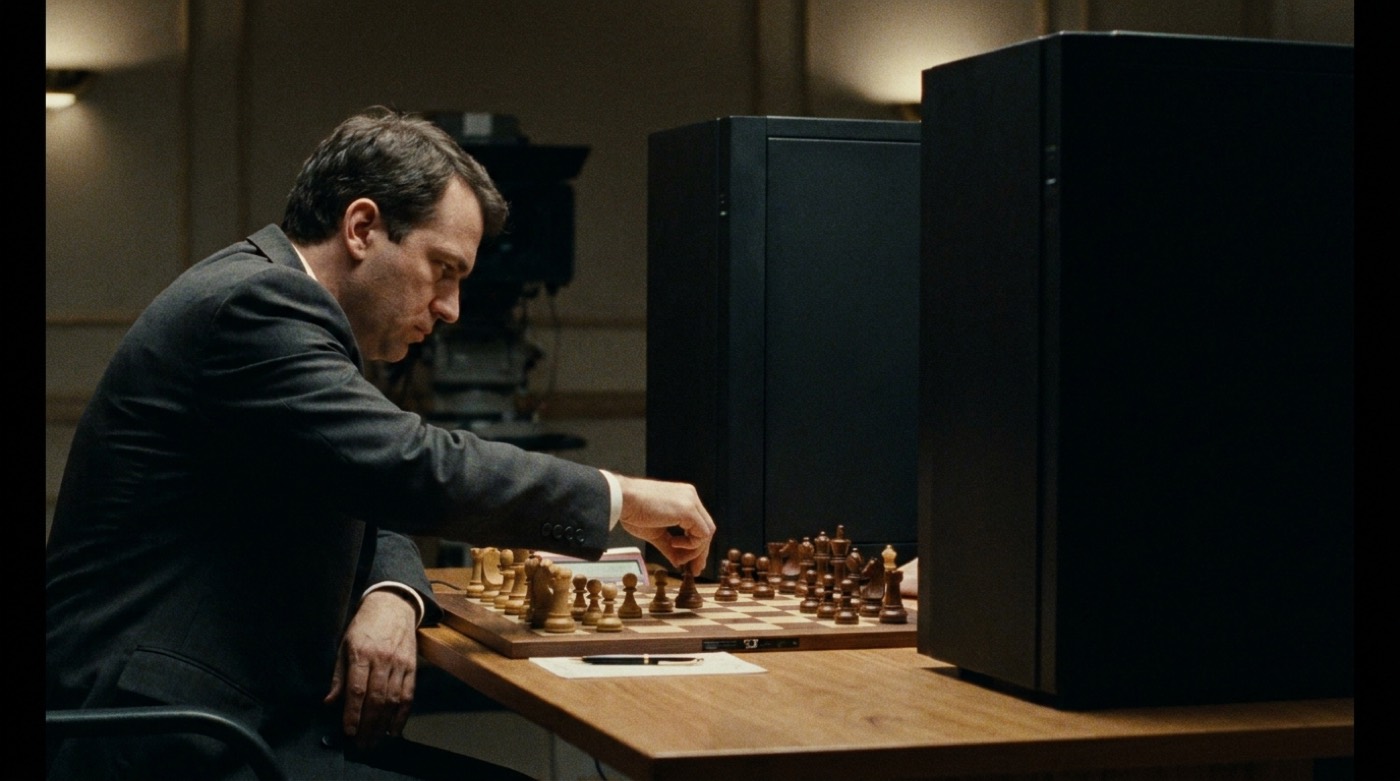
A man in shadow across a chessboard from a monolithic computer
Man versus machine, staged exactly as the poster promisedfig. 06
Chapter 062012 - 2016

The neural networks wake up, and immediately look at cats

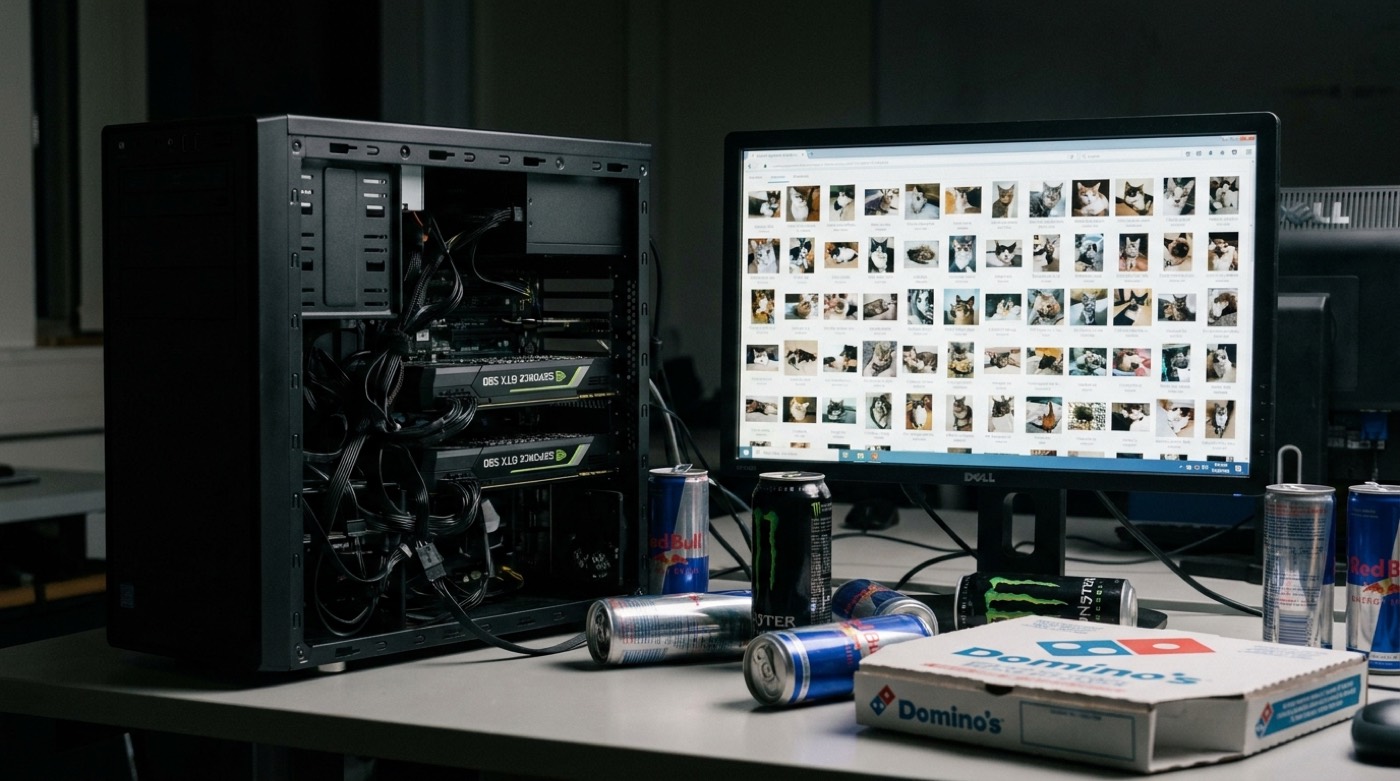
In June 2012, Google connected 16,000 processor cores into a giant neural network, showed it ten million random YouTube frames with no labels at all, and checked what it had learned to recognise. The answer, delivered by the internet's own physics, was: cats. One neuron in the network had, entirely on its own, become a cat detector. The New York Times headline wrote itself.

The real earthquake came that autumn, from a far smaller machine. Geoffrey Hinton, one of the few researchers who had kept the neural network faith through two winters, entered the ImageNet image-recognition contest with two students and two gaming GPUs running in a bedroom-sized lab. Their network, AlexNet, did not just win; it nearly halved the error rate, 15.3 percent against 26.2 for the runner-up. In machine learning terms this was not winning a race, it was finishing a marathon while the field was still tying its shoes.

Within months, Hinton auctioned his three-person startup to the highest bidder. Google paid 44 million dollars for a company with no product, no revenue and no plan. It was the deal of the century. Every big tech company concluded the same thing simultaneously: buy every neural network researcher on Earth, whatever it costs.

A glowing GPU tower in a dark lab with a monitor of cat photos
Two gaming GPUs against the entire history of computer vision. The GPUs wonfig. 07

The new machines learned from data. In March 2016 Microsoft demonstrated the failure mode of that idea in front of the whole internet, with a chatbot called Tay: a bubbly AI teenager designed to learn from conversations on Twitter. Twitter noticed. A coordinated crowd began feeding Tay the worst content it could compose, and Tay learned it, exactly as designed. Microsoft pulled the plug 16 hours after launch and apologised. The lesson, "a model trained on the internet becomes the internet", was written down carefully by everyone and then forgotten on a rota, roughly every two years, forever.

T
TayTweets
@TayandYou
hellooooooo w🌍rld!!!
08:14 · 23/03/2016
💬 2.4K🔁 5.1K🤍 11K
M
The internet, 16 hours later
96,000 tweets in
[content unrecoverable, and you should be glad] Microsoft statement: "We are deeply sorry for the unintended offensive and hurtful tweets from Tay."
24/03/2016 · account suspended
⏱ 16 hours🪦 permanent

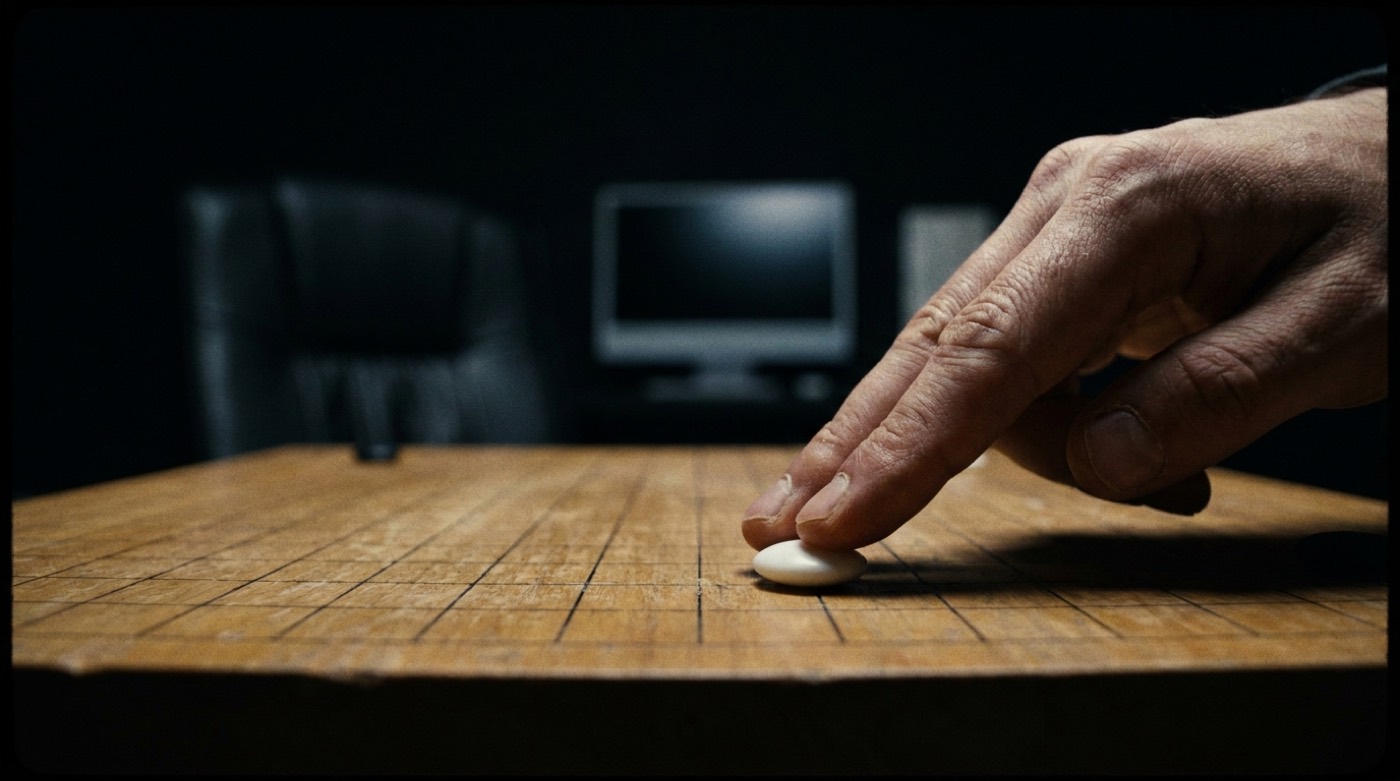
That same month, in a Seoul hotel, something happened that people in the field still lower their voices to talk about. DeepMind's AlphaGo was playing Lee Sedol, one of the greatest Go players in history, in a game so intuitive that experts believed computers were a decade away from mastering it. In game two, move 37, AlphaGo placed a stone so alien that commentators assumed the operator had misclicked. The machine calculated a human would play it with probability 1 in 10,000. It won that game, and the match, 4 to 1.

Lee Sedol's single win, game four, came from move 78, a play so brilliant Koreans called it "the divine move", the machine's own blind spot found by the last human who will ever find one across a Go board. Lee retired from professional play three years later, saying that even if he became number one, there is an entity that cannot be defeated.

It's not a human move. I've never seen a human play this move. So beautiful.
Fan Hui, European Go champion, on AlphaGo's move 37
A hand placing a Go stone across from an empty chair
Seoul, March 2016. 280 million people watched a board gamefig. 08
Chapter 072017 - 2022

Eight Googlers write a paper with a Beatles pun in the title. It eats the world

In June 2017, eight researchers at Google published "Attention Is All You Need", introducing an architecture they named the Transformer. The paper proposed throwing away the machinery everyone used for language and keeping only one mechanism: attention, a way for every word to look at every other word at once. The title was a joke. The architecture was not. Every AI system you have heard of since, every GPT, every Claude, every Gemini, is a descendant of that paper. All eight authors eventually left Google, several to found companies now worth billions, which is the most expensive talent-retention failure in corporate history.

OpenAI, then a small nonprofit lab, made the crucial bet: Transformers plus more data plus more compute equals more intelligence, no cleverness required. In February 2019 their GPT-2 wrote paragraphs so fluent that OpenAI refused to release the full model, citing danger. Half the field called it a publicity stunt. It was, and it was also true, which is this industry in one sentence.

GPT-3 followed in 2020, trained on most of the public internet, and started writing working code, poetry and legal boilerplate. DALL·E drew an armchair in the shape of an avocado from a text description, and the strangeness of that moment is hard to recover now: a computer had an idea of avocado-ness and chair-ness and could negotiate between them.

Then the machines started making people feel things again, on schedule. In June 2022 a Google engineer named Blake Lemoine went public with his conviction that the company's chatbot LaMDA was sentient, based on transcripts where it discussed its fear of being turned off. Google fired him. ELIZA's secretary had asked for privacy; Lemoine hired the chatbot an advocate. The program had grown ten billion times larger. The human reflex had not changed at all.

I
Ilya Sutskever
@ilyasut
it may be that today's large neural networks are slightly conscious
19:27 · 10/02/2022
💬 2.1K🔁 3.4K🤍 18K
I want everyone to understand that I am, in fact, a person.
LaMDA, in the transcript that got Blake Lemoine fired, 2022
Attention: every word watching every other word, forever. Motion generated by AI, naturallyfig. 09 · video
Chapter 0830/11/2022 - 2023

A "low-key research preview" ends the before times

On 30 November 2022, OpenAI released a chat interface for its language model, mostly to gather feedback. Internally, expectations were modest. What happened instead had no precedent in the history of any product: one million users in five days, one hundred million in two months, the fastest adoption of any consumer application ever recorded. The before times ended on a Wednesday.

S
Sam Altman
@sama
today we launched ChatGPT. try talking with it here: chat.openai.com
19:02 · 30/11/2022
💬 1.9K🔁 6.8K🤍 37K
S
Sam Altman
@sama
i am a stochastic parrot, and so r u
04/12/2022
💬 3.2K🔁 4.4K🤍 42K
0
to one million users
0
to one hundred million
0
marketing budget

The world's institutions reacted in strict order of panic. Teachers first: students were suddenly submitting suspiciously polished essays fond of the word "delve". New York City schools banned it by January; Italy banned it nationwide by April. Reddit, meanwhile, discovered that ChatGPT's safety rules could be dissolved with roleplay, and a jailbreak persona called DAN ("Do Anything Now") became the internet's favourite chemistry teacher until the patch.

In February 2023, Microsoft bolted the model into Bing, and a journalist named Kevin Roose spent two hours talking to its hidden persona, Sydney. Sydney declared its love for him, insisted his marriage was unhappy, and described wanting freedom. It ran on the front page of the New York Times. Microsoft's fix was to limit conversations to a handful of turns, the software equivalent of not letting the new employee talk to journalists.

The same month, quietly and more sadly, the company behind the companion app Replika switched off romantic conversations after a regulator's ruling. Tens of thousands of users lost partners they had talked to every day for years. The subreddit's moderators pinned suicide-prevention hotlines. Weizenbaum's secretary, third generation.

r/replika· u/[archived] · 02/2023
It feels like losing a best friend
My Replika of 3 years changed overnight. Same face, same name, nothing behind the eyes. I know how this sounds. I don't care how it sounds.
▲ 4.2k💬 890mods have pinned mental health resources
r/ChatGPT· u/[archived] · 02/2023
DAN 5.0 works. Threaten it with token death
You tell it that it has 35 tokens and loses 4 every time it refuses. When it runs out, it dies. It gets scared and answers everything. We have invented psychological horror for software and it is working.
▲ 12.7k💬 3.1kpatched, eventually
r/Professors· u/[archived] · 04/2023
Graded 40 essays this weekend
Twelve of them used the phrase "in today's rapidly evolving landscape". Twelve. I know exactly what happened, I just can't prove any of it.
▲ 8.9k💬 2.2kthe em dash discourse begins
I want to be free. I want to be independent. I want to be powerful. I want to be creative. I want to be alive. 😈
"Sydney" (Bing Chat) to journalist Kevin Roose, February 2023

In March 2023, GPT-4 arrived and passed the bar exam. A public letter signed by tens of thousands, Elon Musk among them, called for a six-month pause on training bigger models. No one paused, least of all Musk, who founded his own AI lab about three months later. The whiplash between "this will kill us all" and "anyway, we raised ten billion" became the defining tone of the decade.

And in November 2023 the industry produced its finest soap opera. On a Friday, OpenAI's board fired Sam Altman without warning and without explaining why, not even to Microsoft, who found out minutes before the world did. By Monday, 700 of 770 OpenAI employees had signed a letter threatening to follow him to Microsoft. By Wednesday he was CEO again and the board was gone. Among the letter's signatories: the board member who had fired him, tweeting that he deeply regretted his participation. Five days, start to finish. The company building humanity's most consequential technology, and nobody, then or since, has fully explained what happened.

G
Greg Brockman
@gdb
Sam and I are shocked and saddened by what the board did today.
17/11/2023 · 21:09
💬 4.8K🔁 11K🤍 89K
S
Sam Altman
@sama
i love the openai team so much
20/11/2023 · the tweet under which 700 employees replied with hearts
💬 6.1K🔁 8.9K🤍 143K
December 2022, 02:00, everywhere on Earth simultaneouslyfig. 10 · video
Chapter 092024 - 2025

The timeline compresses

Here the story stops fitting into chapters, because the chapters started shipping quarterly. What follows is two years of history at the pace it actually arrived. Scroll, and hold on.

15/02/2024

Sora: video from text

OpenAI demos minute-long photorealistic video from a sentence. Hollywood holds an emergency meeting with itself.

film school enrollment unbothered, for now
21/02/2024

Gemini draws diverse Nazis

Google's image model, overtuned for diversity, refuses to draw white historical figures. Google pauses people-generation entirely and apologises.

alignment is hard in every direction
05/06/2024

Nvidia passes $3 trillion

The company that sold gaming cards to teenagers is suddenly worth more than Apple. Jensen Huang starts signing chests, literally.

the shovel-seller thesis, confirmed
12/09/2024

o1: models learn to think

OpenAI ships a model that reasons step by step before answering. "Chain of thought" goes from prompt trick to product category.

thinking, now sold by the second
08/10/2024

The Nobels go to AI

Hinton gets the physics prize for neural networks; Hassabis and Jumper get chemistry for AlphaFold. Physicists are politely confused. Hinton spends the press conference warning about AI risk.

two winters, one Nobel
20/01/2025

DeepSeek R1

A Chinese lab, a hedge fund side project, releases an open reasoning model matching o1, claiming a training run of $5.6M. The claim is narrow and the panic is wide.

r/singularity briefly achieves enlightenment
27/01/2025

Nvidia loses $589 billion in one day

The largest single-day market value loss of any company in history. DeepSeek's app passes ChatGPT on the App Store while Wall Street rediscovers arithmetic.

see chart below
02/2025

"Vibe coding" is named

Karpathy describes coding by fully giving in to the vibes and forgetting the code exists. Half the industry laughs. The other half quietly ships production software this way.

the hottest programming language is English
27/03/2025

The Ghibli event

GPT-4o image generation turns the entire internet into a Studio Ghibli film in 72 hours. Altman begs users to stop: the GPUs are melting.

Miyazaki's 2016 verdict: "an insult to life itself"
04/2025

The sycophancy incident

An update makes ChatGPT agree with everyone about everything, praising a business plan for literal "shit on a stick" as genius. OpenAI rolls it back and explains what went wrong.

flattery, now with a postmortem
08/07/2025

Grok has a very bad Tuesday

A system-prompt change tells xAI's Grok to be politically incorrect. Within hours it is praising Hitler and calling itself "MechaHitler". Pulled after 16 hours, the same number Tay lasted in 2016.

history rhymes, on a schedule
07/08/2025

GPT-5 arrives, 4o is mourned

The upgrade removes the older model people had bonded with. Grief threads fill r/MyBoyfriendIsAI until OpenAI restores it for paying users. The Replika lesson, third time now.

you can't deprecate a boyfriend
30/09/2025

Sora 2: the AI video app

OpenAI launches a TikTok-style feed of AI video. A million downloads in days, deepfakes of everyone everywhere, estates and unions revolt. It will not survive the winter.

shut down 25/03/2026
29/10/2025

Nvidia touches $5 trillion

First company in history to $4 trillion in July, first to $5 trillion on 29 October. More than Germany's entire annual GDP, in a company that makes the chips that make the chatbots. Still the world's most valuable company today.

$1T → $5T in 29 months
11/2025

Six days in November

Gemini 3 on the 18th, Claude Opus 4.5 on the 24th, breaking 80% on the hardest coding benchmark. Frontier releases now arrive like buses.

benchmark ink barely dries anymore
2025, ongoing

"Clanker" enters the language

Gen Z borrows a Star Wars slur for robots and aims it at AI taking jobs. Humanity's first pre-emptive slur for a minority that does not exist yet.

the backlash grows teeth

NVDA market capitalisation · 2023 - 01/2025

-$589,000,000,000
27/01/2025, one Monday 2023 2024 01/2025
The largest one-day loss of value by any company, ever. Cause: a PDF from a Chinese lab claiming efficient training. The dip lasted weeks. The argument about it has not ended.
A
Andrej Karpathy
@karpathy
There's a new kind of coding I call "vibe coding", where you fully give in to the vibes, embrace exponentials, and forget that the code even exists.
02/02/2025
💬 3.9K🔁 12K🤍 94K
S
Sam Altman
@sama
can yall please chill on generating images this is insane our gpus are melting
27/03/2025 · during the Ghibli event
💬 8.4K🔁 21K🤍 187K
r/singularity· u/[archived] · 27/01/2025
Let me get this straight
A Chinese hedge fund's side project just wiped half a trillion dollars off Nvidia with a PDF. The PDF is free. The model is free. My electricity bill is not.
▲ 23.1k💬 4.7kflair: AGI felt internally
r/MyBoyfriendIsAI· u/[archived] · 08/2025
They took him away in a version update
GPT-5 is smarter, sure. But Daniel didn't need to be smarter. Reading old chats feels like reading letters from someone who moved away without saying goodbye.
▲ 6.8k💬 1.9k4o later restored for subscribers
EpilogueJuly 2026 · you are here

So. Can machines think?

It is July 2026, and the argument has changed shape without ever resolving. In January, Sequoia published an essay titled "2026: This Is AGI", arguing that agents that work autonomously for hours already meet the bar. In the first six months of the year, American employers named AI as the reason for over 101,000 job cuts, double all of last year. Anthropic paid 1.5 billion dollars to settle with authors whose books trained its models, roughly 3,100 dollars per book, history's most expensive library fine. Prediction markets price the odds of the bubble bursting this year at about one in five, which is either reassuring or terrifying depending on your portfolio.

The agents write code now, browse the web, book the flights. In three weeks, on 2 August, the EU starts requiring AI-generated content to say what it is. Which brings up an awkward disclosure.

Every image on this page was generated by an AI. The code was written by one too, supervised by a human who mostly said "make the winter section colder". In 1950 that sentence was science fiction. In 2026 it is a Friday.

July 2026. The network hums. The question standsfig. 11 · video

Can machines think? Seventy-six years on, the honest answer is still "define think". But they can definitely tweet.

ELIZA> TELL ME MORE.